Bangladesh Becomes Eligible for U.S. DFC Financing
 Faiaze Ibne Kabir · 17 Nov 2026

3 min read
The U.S. International Development Finance Corporation (DFC) said on 16 November 2026 that projects in Bangladesh are now eligible for its financing. The agency, which describes itself as the international investment arm of the U.S. government, said the status creates an opportunity to address the country’s economic development needs by mobilizing private investment.
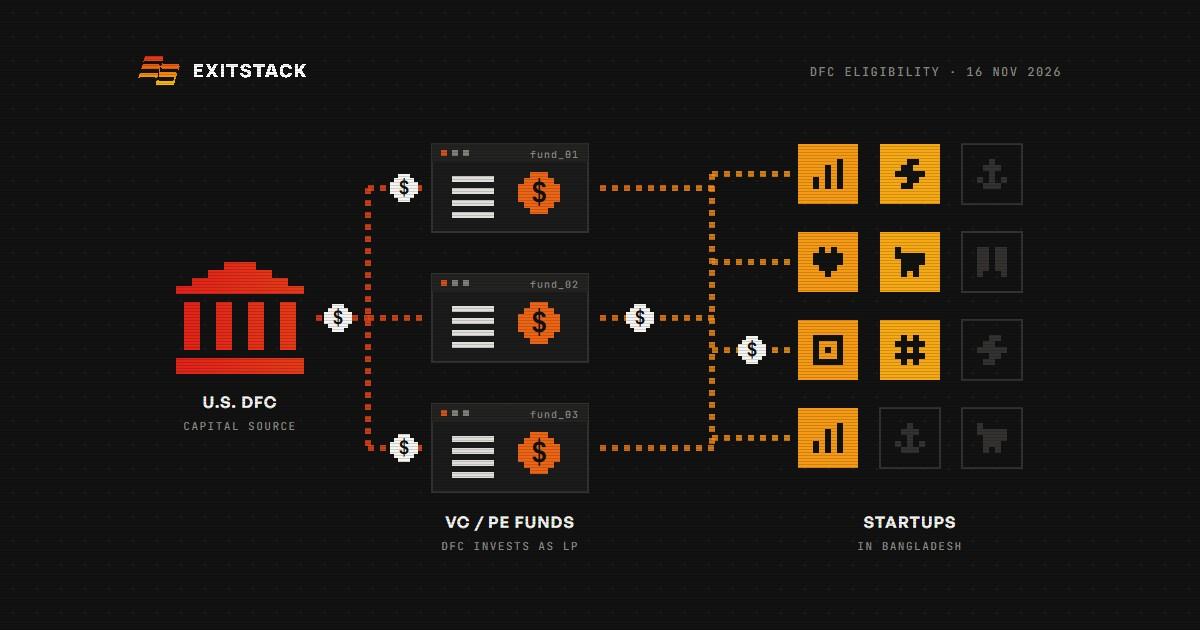
Why It Matters For Investors: DFC invests in private equity and venture capital funds as a limited partner, in addition to lending to and investing in companies directly. Until now, Bangladesh sat outside its remit. In public summaries of at least two fund commitments, A.P. Moller Capital’s Emerging Markets Infrastructure Fund II and Copenhagen Infrastructure Growth Markets Fund II, DFC listed Bangladesh as a country where it was closed and said it would be treated as an “excused investor,” meaning its capital would sit out any deal the fund made there. DFC’s filings tie that treatment to Bangladesh’s closed status, which ended with the 16 November announcement.
What DFC Offers: The agency’s products include direct loans with tenors of up to 25 years, guaranties for lenders, political risk insurance, direct equity, and debt and equity for private funds, according to its website. DFC’s venture commitments elsewhere in Asia include up to US$30Mn as a limited partner in Openspace Ventures Plus, a later-stage fund focused on Southeast Asia. The announcement did not name projects, financing amounts, or timelines for Bangladesh.
The Background: The U.S. State Department’s Investment Climate Statements for 2021 to 2024 noted that DFC was not authorized to operate in Bangladesh. DFC’s fund summaries gave labor rights as the reason Bangladesh was closed. The eligibility follows the United States-Bangladesh Agreement on Reciprocal Trade, signed on 9 February 2026, under which the U.S. set its reciprocal tariff on Bangladeshi goods at 19%.
In Their Words: “Bangladesh’s eligibility for DFC financing marks an important opportunity to deepen our economic partnership and mobilize private investment that delivers lasting growth. By supporting projects that strengthen critical infrastructure, we can unlock economic opportunity for Bangladesh while advancing U.S. strategic interests,” said Ben Black, CEO of DFC.
“The United States believes that promoting open economies and reciprocal trade will spur economic growth in Bangladesh, and the Agreement on Reciprocal Trade is our public commitment to supporting Bangladesh through this process. DFC financing can play an important role in making that vision a reality – spurring further prosperity in both of our countries,” said Brent T. Christensen, U.S. Ambassador to the People’s Republic of Bangladesh.
What The Ecosystem Is Saying: “Bangladesh’s much-awaited inclusion in the DFC eligible countries list can unlock patient capital for our energy, telecom, ICT and financial services infrastructure, and pave the way for rapid adoption of digital technology by our nearly 200 million consumers.
“This can be a game-changer for our homegrown technology companies. With increased flow of capital - both into the digital infrastructure, as well as directly into some of the tech companies already operating at scale - we can now build for a much larger market, in Bangladesh and beyond,” said Fahim Ahmed, Chief Executive Officer of Pathao.
“For more than a decade, many global venture capital and private equity firms couldn’t invest in Bangladesh because DFC was an investor in their funds. Now that Bangladesh is eligible, those funds are back in play for Bangladeshi companies, from traditional businesses to growing startups. More importantly, it sends a signal to global investors that Bangladesh is an increasingly credible destination for their capital,” said Rahat Ahmed, Founder & Managing Partner of Anchorless Bangladesh.