


Heading
This is some text inside of a div block.


Bangladesh is rarely the first country that comes up in conversations about Asia’s agri-tech opportunity. India has the scale, Indonesia has the natural-resource base, Vietnam has the export story, and Thailand has the food-processing ecosystem. Bangladesh is often overlooked.
Yet agriculture remains a US$50 billion+ sector in Bangladesh, representing roughly 11% of GDP and more than one-third of total employment. On agricultural fundamentals, the country is one of the world’s most remarkable production systems.
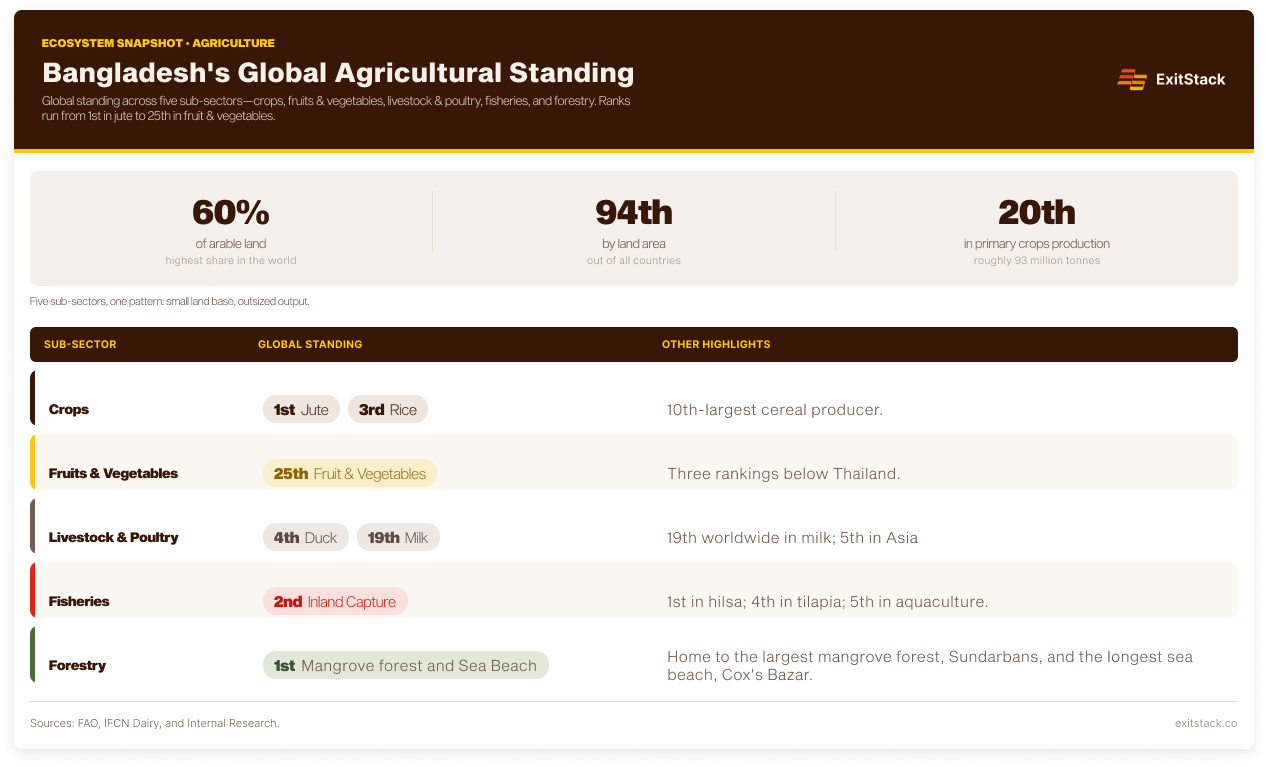
For a country that ranks only 94th globally by land area, Bangladesh produces far above its geographic weight. Around 60% of its land is arable, the highest share in the world and more than six times the global average, giving the country an unusually dense agricultural base. That intensity is reflected in its production rankings. Bangladesh is the world's largest producer of jute and third-largest producer of rice. It is also among the world's leading producers of vegetables, fruits and milk. In 2022, it overtook China to become the world's second-largest producer of inland capture fish, behind only India.
In other words, agricultural scale is not the issue. Bangladesh already has the density, output, labour force, and production complexity that should make it a compelling market for technology-led value creation. And yet, the technology layer remains thin.
According to LightCastle Partners’ startup funding data, food and agriculture startups in Bangladesh have attracted more than US$45 million in funding, roughly 4% of the country’s total startup funding of about US$1.1 billion to date. Even that overstates the depth of true agri-tech funding. The category includes grocery-adjacent consumer retail companies such as Chaldal and Apon Bazaar. Excluding those models, funding into more directly agriculture-linked startups falls closer to US$13 million, or less than 1.2% of total startup capital.
.png)
That gap is where the puzzle starts. Why has such a large, productive, agriculture-intensive economy produced so little venture-backed agri-tech companies?
This underfunding is not unique to Bangladesh. It reflects a broader tension in food and agriculture globally: the sector is enormous in the real economy, but structurally difficult for venture capital.
Globally, agrifoodtech startups have raised more than US$200 billion since 2014. Yet the sector still accounts for only a small share of venture capital. According to AgFunder, agrifoodtech represents just 5.5% of global VC investment. That is strikingly low for an industry that contributes at least 15% to global GDP, supports more than half the world’s workforce, and accounts for roughly one-third of global greenhouse gas emissions.
The mismatch is even clearer in South and Southeast Asia, where agriculture remains central to the economy. Across India and Southeast Asia, there are 92 unicorns in total, but only four are in food and agriculture: DealShare, Rebel Foods, Licious, and Kopi Kenangan. Even these are not farmer-facing agri-tech companies in the narrow sense. They are largely consumer retail, foodservice, or branded food models. DealShare is social commerce and grocery retail. Rebel Foods is a cloud-kitchen platform. Licious is a D2C meat and seafood brand. Kopi Kenangan is a coffee retail chain. They sit closer to the consumer end of the value chain than the farm.
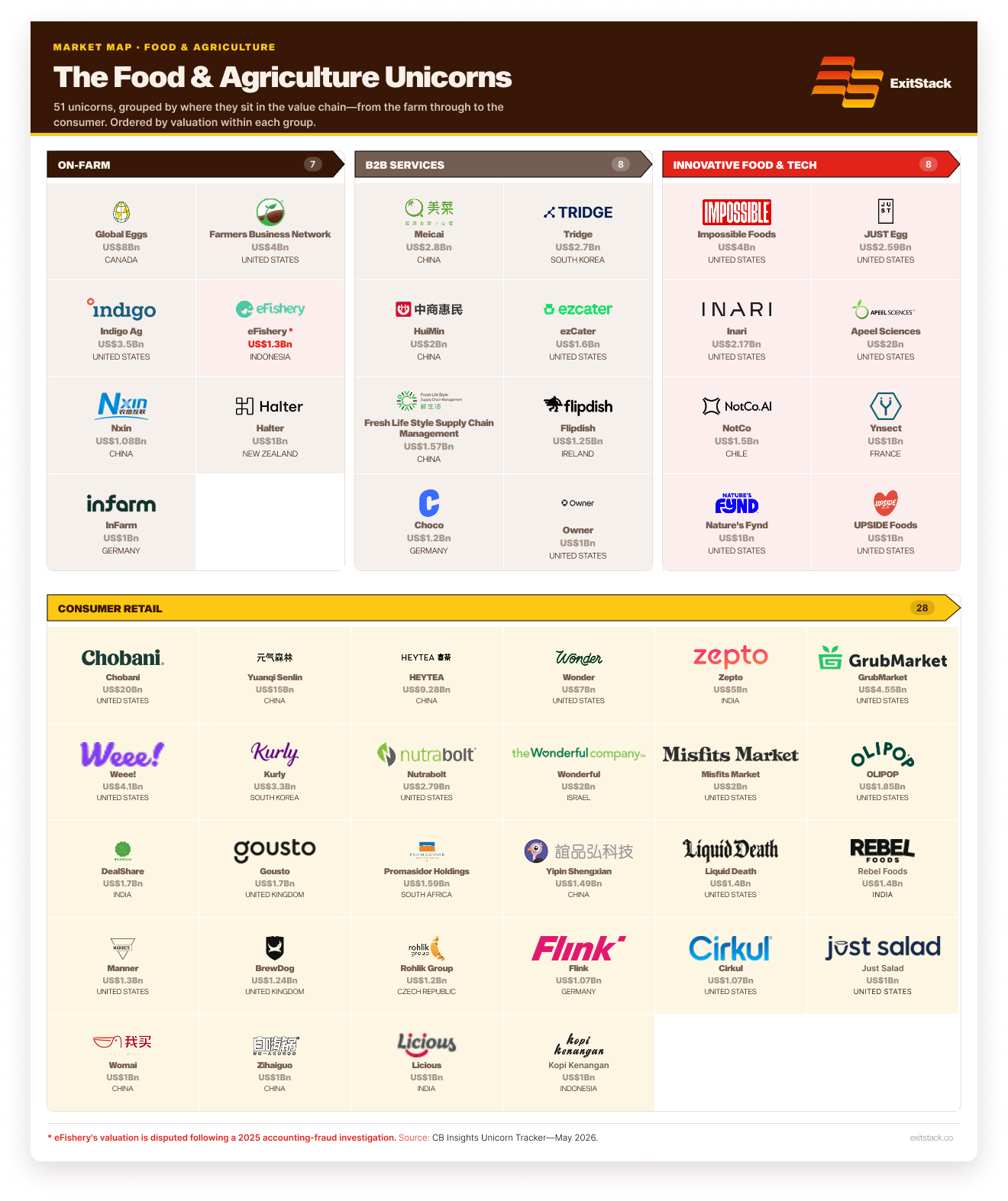
That distinction matters. Food and agriculture can produce large companies, but the venture outcomes so far have mostly emerged where the customer is urban, digitally reachable, and relatively frequent in consumption. The closer a company moves to the farmer, the harder the economics become.
This is the structural issue investors across the region have had to confront. Agriculture in South and Southeast Asia is not one unified market. It is a set of fragmented local systems shaped by smallholder farmers, informal value chains, crop-specific economics, local regulation, physical distribution, and trust-based relationships. What works in one geography may not transfer easily to another. Even within a single country, expanding from one crop, district, or buyer network to another can feel less like scaling software and more like rebuilding operations from scratch.
This is what some regional investors describe as the “Series C trap.” Early-stage agri-tech ventures can show strong local traction, particularly when they are tightly focused on one crop, geography, or value chain. But once they raise larger rounds and try to expand across borders or multiple verticals, the model often begins to strain. Growth starts demanding new field teams, buyer relationships, and local trust. The total addressable market may look enormous, but the operating system does not scale cleanly.
The first wave of regional agri-tech failures exposed the limits of this playbook. Several lessons now look clear: unit economics matter more than total addressable market; direct-to-farmer models remain prohibitively expensive unless they are deeply embedded in transactions; premature regional expansion is unsustainable without single-market dominance; and execution, distribution, and working-capital discipline often determine survival more than technology alone.
This does not mean the sector is uninvestable. It means investors have to calibrate their expectations differently.
In agri-tech, the right outcome may not always be a billion-dollar unicorn. Attractive venture returns can still come from companies that exit in the US$200 million to US$400 million range, especially when investors enter early, maintain disciplined ownership, and avoid overcapitalizing models before the unit economics are proven. In a sector where growth is operationally heavy and liquidity is often strategic, the path to returns may look different from software, fintech, or consumer internet.
And corporate partnerships have become an increasingly important route to that liquidity. Across the broader South and Southeast Asian agri-tech ecosystem, corporate acquisitions account for roughly three-quarters of exits since 2020, while only a small number of IPOs have taken place. The implication is that strategic fit may matter just as much as scale when building an enduring agri-tech business.
For Bangladesh, this context is important. The country's thin agri-tech funding base should not be read simply as investor neglect. It is part of a wider global pattern: agriculture is a massive market in aggregate, but difficult to turn into venture-scale companies because the customer base is fragmented, seasonal, operationally demanding, and often low-margin. And these structural constraints become most apparent at the farmer level.
Farmers are one of the hardest markets in the world to build for, not because they are unsophisticated, irrational, or resistant to progress, but because they are rational economic actors operating under constraints most software markets never face.
For most technology companies, adoption begins with access. A user owns a smartphone, spends time online, discovers a product through advertising, and can start using it almost instantly. That is the foundation on which much of consumer internet, fintech, and commerce has scaled. Digital distribution reduces the cost of acquiring users, product usage generates data, retention compounds, and monetization follows.
Agriculture breaks this loop at almost every step.
The first problem is access. Mobile phone ownership may be widespread, but smartphone ownership and regular internet usage are not the same thing. For lower-income rural households, the cost of a smartphone, the recurring cost of mobile data, and the practical demands of farm work all matter. A farmer working in mud, water, heat, rain, or a fish pond is not interacting with a phone the way an urban consumer does in an office, bus, or café. Even when the device exists, the context of usage is different.
The second problem is digital comfort. A farmer may use mobile money, Facebook, YouTube, or messaging apps, but that does not automatically translate into comfort with an agriculture-specific app, especially one that requires data entry, crop records, or inventory management. Literacy, digital literacy, and trust all shape adoption. For many farmers, a human intermediary remains more credible than a dashboard. The local input dealer, extension officer, or neighboring farmer is not just a channel of information; they are part of the decision-making infrastructure.
The third problem is risk. Farming is a seasonal, capital-constrained business where one wrong decision can affect an entire crop cycle. A restaurant owner can test a new POS system and switch back next month. A shopkeeper can try a new supplier on a small batch. A farmer deciding on seeds, fertilizer, pesticide, or crop choice often has fewer chances to experiment. The downside is not a bad user experience. It is lower yield, crop failure, debt pressure, or the inability to finance the next season.
That makes farmers cautious in ways that are economically rational. Many are already operating with tight working capital. Cash from one harvest is often recycled into the next season’s inputs, household expenses, and loan repayments. The farmer’s financial life is lumpy: costs arrive before revenue, while revenue depends on weather, disease, market prices, and buyer behavior. In this environment, “try this new product” is not a light ask. It is a family security bearing decision.
This creates a difficult equation for startups.
In most venture-scale software businesses, the ideal user is digitally reachable, frequently active, and monetizable. Farmers are often the opposite. They are expensive to reach, irregular in usage, and hard to monetize directly.
Customer acquisition is rarely purely digital. A startup often needs field officers, demo plots, call centers, or village-level campaigns to onboard farmers. That makes the first unit of growth expensive. But unlike urban consumer businesses, that acquisition cost does not always amortize quickly, because usage frequency can be seasonal. A farmer may need advice intensively during planting, pest outbreaks, irrigation decisions, harvest, or sale, but not every day in a predictable software-like rhythm.
Retention is also harder. Many agri-tech products require nudging, training, follow-up, and trust-building. A farmer may sign up once but not return unless someone reminds them, unless the product is embedded into an existing transaction, or unless the service solves a problem at the exact moment it becomes urgent. This is very different from categories like payments, food delivery, ride-hailing, or messaging, where user behavior is naturally frequent.
The monetization challenge is even sharper. If the end-user is a small farmer, the ability to charge meaningful subscription fees or software margins is limited. Many farmers are not unwilling to pay; they are unable to pay enough to support a high-touch technology business. This forces agri-tech startups into indirect business models. Instead of charging farmers, they monetize through input commissions, output trading margins, SaaS fees from agribusinesses, or data and procurement services for larger value-chain actors.
That is often necessary, but it creates a second-order problem: the person receiving the value is not always the person paying for it. A farmer may benefit from better advisory, better input access, or better market linkage, while the startup earns from an input company, trader, financier or corporate buyer. This makes the business model more complex than a simple farmer-facing app. The startup is no longer just building software; it is coordinating a multi-sided value chain.
And agriculture value chains are operationally heavy. Inputs need to be sourced, verified, financed, delivered, and used correctly. Produce needs to be aggregated, graded, stored, transported, and sold. Financing needs underwriting and recovery. Advisory needs localization by crop, geography, soil condition, weather, and farmer behavior. A model that looks scalable on a pitch deck often becomes a field-force business in practice.
This is why agri-tech has often looked more like tech-enabled distribution than pure technology. The most promising companies are rarely just apps, they are networks: of farmers, suppliers, buyers and data systems. That can create defensibility, but it also slows growth and compresses margins. Scaling does not simply mean acquiring another thousand users online. It often means entering another region, building trust from scratch, hiring field teams, managing local politics, handling working capital, and adapting to new crop economics.
Bangladesh adds another layer to this structural difficulty. Its agricultural base is enormous, but highly fragmented. Average farm size is only around 0.5 hectares, roughly one-third of the South Asian average, and the farmer base is spread across millions of households. That means a startup has to aggregate a much larger number of farmers to generate the same GMV, financing book, or input volume that might be achieved with fewer, larger farms elsewhere.
This has direct implications for venture outcomes. Smaller farm sizes translate into lower transaction values and lower revenue per farmer, forcing startups to acquire many more users, increase take rates, or layer additional services onto the same customer relationship. Yet every additional farmer still requires education, onboarding, trust, and ongoing support. As the customer base grows, so does the operational complexity. The opportunity is enormous in aggregate, but expensive to unlock farmer by farmer. That helps explain why agri-tech has attracted sustained interest but produced relatively few breakout companies.
Yet the opportunity remains. The lesson from the last decade is not that agri-tech cannot work, but that building for farmers is fundamentally different from building for consumers. The companies most likely to succeed will be those that reduce the cost of trust, distribution, financing, and coordination across the value chain.
That was also the clearest takeaway from a recent Globesight-convened agri-tech roundtable in Dhaka with policymakers, founders, researchers, and investors. The discussion was not about building more apps for farmers, but about using technology to strengthen the systems around them. That is precisely where AI could begin to change the equation.
This is where the story starts to change. For the first time, the structural barriers that made farmers expensive to reach, difficult to retain, and hard to monetize are beginning to look less fixed. The rise of AI, local-language interfaces, image recognition, and automated advisory systems, could meaningfully alter the cost structure of agri-tech.
Historically, one of the biggest constraints in this sector was the need for human intermediation. A farmer often needed someone to explain the product, diagnose the issue, remind them to use it, interpret the recommendation, and follow up after adoption. That made customer acquisition and retention labor-intensive. AI does not remove the need for human trust, but it can reduce the cost of serving, re-engaging, and supporting farmers once that trust exists.
A farmer who may never fill out a form or navigate a complex app might still ask a question through voice. A farmer who cannot describe a pest in technical language might still upload a photo. A farmer who does not check an app daily might still respond to a timely voice prompt before irrigation, fertilizer application, disease treatment, or harvest. This matters because AI can turn digital products from tools farmers have to learn into interfaces that meet farmers where they already are: in local language, through voice, at the moment of need.
Imagine a Bangla voice-based advisory service that allows a farmer to describe a pest problem, upload a crop photo, receive a localized recommendation, check whether the required input is available nearby, and later use that interaction history to support a small seasonal financing. The value is not the chatbot itself. The value is the chain it helps connect.
The same logic applies beyond crop advisory. The next generation of Bangladeshi agri-tech may emerge from less obvious but highly practical use cases.
One is fresh produce quality. Bangladesh is a major producer of fruits and vegetables, but quality disputes, adulteration concerns, spoilage, and inconsistent grading all reduce trust between farmers, traders, retailers, and consumers. Globally, companies such as Clarifresh are using computer vision to automate fresh produce quality control, while large retailers such as Albertsons have begun deploying AI tools to inspect fruits for defects, bruising, decay, and other quality issues. In Bangladesh, a similar model could start not as a sophisticated export platform, but as a simple quality-verification layer at collection points, wholesale markets, or packhouses helping farmers prove quality, buyers reduce disputes, and consumers trust what they are buying.
Another is aquaculture. Feed is often the largest cost in fish farming, with FAO research putting aquafeeds at roughly 50–70% of production costs in many operations. That makes biomass detection, feeding optimization, and water-quality monitoring especially important in a country where inland fisheries and aquaculture are central to food security and rural income. Companies such as UMITRON, Aquabyte, and XpertSea point to where the sector is heading: computer vision, sensors, and AI systems that estimate fish or shrimp size, monitor appetite, optimize feeding, and help farmers decide when to harvest. AI will not solve aquaculture by itself, but tools that improve feed efficiency, survival rates, and harvest timing can directly affect pond economics in ways farmers can see.
But the lesson from agriculture remains the same: technology adoption follows proof, not promise.
For farmers, the product has to work in the field, not just on a screen. The benefits must be tangible: lower input costs, higher yields, better survival rates, reduced disease, faster credit access, or a better realized price after sale. Farmers are unlikely to pay upfront for theoretical value, especially when the downside of experimentation is borne by them. The most effective models may therefore be those where the startup earns only after value is created, sharing both the upside and part of the execution risk.
This also means the early phase of agri-tech should be judged differently from other startup categories. In consumer internet, validation can happen in weeks. In agriculture, validation often takes seasons. A rice crop, a vegetable cycle, a fish harvest, a dairy productivity improvement, or a livestock intervention cannot be accelerated to fit a reporting timeline. One good cycle may be luck. Two or three cycles begin to suggest repeatability. Only after that does scale become meaningful.
So the next generation of agri-tech in Bangladesh should not be built around quantity first. It should be built around quality first. The goal should not be to onboard the largest number of farmers in the shortest possible time. The goal should be to prove, with a focused farmer base, that the product changes outcomes in a way farmers can see, trust, and repeat.
That requires patient capital. It requires founders willing to spend time in fields, ponds, markets, and warehouses, rather than only in dashboards. It requires investors who understand that agricultural traction may look slower at first because the feedback loops are biological, seasonal, and trust-based. And it requires companies that are willing to build with farmers, not simply sell to them.
It also requires public infrastructure that makes responsible scaling easier: cleaner agricultural data, farmer registries that startups can build around with consent, startup-friendly pilot pathways, sensible rules for public-private partnerships, lower transaction costs for small agricultural payments, and demonstration programs that test value over multiple crop cycles. AI can reduce the cost of coordination, but policy can reduce the cost of fragmentation.
If that happens, Bangladesh’s agri-tech opportunity could look very different in the AI era. The country has the density, production base, farmer population, and agricultural urgency to support large outcomes. What it has lacked is a scalable way to bridge trust, advice, finance, and market access across millions of small producers.
AI will not solve all of that by itself. It will not replace field presence, farmer relationships, institutional coordination, or the need to prove value over multiple seasons. But it may finally make coordination cheap enough, and intelligence accessible enough, for Bangladesh’s agricultural scale to become investable in a way that is also genuinely useful to farmers.
That is the real shift. The last decade showed why agri-tech was hard. The next decade may show why it was worth waiting for.