Jiji Acquires Bangladesh's Bikroy in Its First Deal Outside Africa
Insight
Created:
May 13, 2026
Updated:
May 13, 2026
Subscribe to our Newsletter
Thank you! Your submission has been received!
Oops! Something went wrong while submitting the form.
Thirteen months after entering Bangladesh as a direct competitor, African e-commerce giant Jiji has acquired Bikroy, the country’s largest online classifieds marketplace — its first acquisition outside Africa and a move that gives it instant category leadership in one of South Asia’s fastest-growing digital economies, reports TechCabal, a Lagos-based tech publication.
Anton Volianskyi, Jiji’s chief executive officer, declined to disclose the transaction value but confirmed the deal was funded through “internal resources and shareholder support.”
The acquisition is the second time Jiji has bought a marketplace from Sweden-based Saltside Technologies, which built and operates classifieds platforms across emerging markets. In 2022, Jiji acquired Saltside’s Ghanaian platform, Tonaton, after years of competing head-to-head in the same market. Saltside, backed by Kinnevik, Hillhouse Capital, and Brummer & Partners, has raised approximately $65 million across its lifetime and now retains only one major operating asset: Ikman, in Sri Lanka.
“This is a deliberate strategy, and we are direct about it,” Volianskyi said in an email to TechCabal. “In each case, the sequence is the same: enter organically to validate the opportunity, build a competitive position on the ground, and then evaluate whether organic scaling or consolidation gets us to category leadership faster.”
The compete-then-buy playbook
Jiji’s approach to Bangladesh was textbook. When it launched jiji-bd.com in March 2025, the company publicly framed it as a long-term play against incumbents — Bikroy, Daraz, and Ajkerdeal — while privately applying competitive pressure. Within 13 months, it had bought its largest rival.
The pattern is not new. In 2019, Jiji acquired OLX Africa’s operations in Nigeria, Kenya, Ghana, Uganda, and Tanzania after years of head-to-head competition, pushing its monthly audience above eight million users in a single stroke. Tonaton in Ghana followed in 2022. Bikroy is the third competitor Jiji has absorbed in six years.
“We launched jiji-bd.com to test our playbook on the ground in Bangladesh, build operational presence, and put real competitive pressure on the market. Within months, the dynamics had shifted significantly, and consolidation became the most efficient path forward for both sides,” Volianskyi said.
Why Bikroy matters
Founded in October 2012 by Saltside Technologies, Bikroy is the dominant classifieds platform in Bangladesh, a country of 175 million people with 131 million internet users. The platform has recorded more than 10 million app downloads since launch, serves over 400,000 monthly buyers and more than 100,000 monthly sellers, and processes more than $3 billion in annual gross merchandise value (GMV) — concentrated in high-value categories like real estate and vehicles, mirroring Jiji’s core categories across Africa.
The platform employs around 420 people and reaches roughly three million unique visitors a month. It was first described as Bangladesh’s “first bilingual classified website” by The Daily Star in 2012 and reached operating break-even in August 2019.
For Jiji, which now describes itself as serving over 90 million annual users and processing $70 billion in annual GMV across its platform, the Bikroy acquisition brings a well-established brand with more than a decade of consumer trust — something that cannot be built quickly.
“That kind of brand equity and category leadership takes more than a decade to build, and replacing it would destroy meaningful value,” Volianskyi said.
What changes for Bikroy
The Bikroy brand will remain. Volianskyi was emphatic that preserving it is “central to the investment thesis.”
Under Jiji’s ownership, four things will change: the underlying technology platform, the monetisation model, marketing investment, and seller package architecture. Bikroy will move onto Jiji’s technology stack, built for small businesses and professional sellers. The flat-fee pricing model will be replaced by a performance-based bidding system — sellers pay only when shoppers click on their listings, and set their own bids and daily spending caps. Jiji will increase marketing spend to drive more shoppers to the platform, a playbook it has used consistently in Africa.
Bikroy’s local team across commercial, operations, customer support, sales, marketing, and finance will continue to operate under a locally incorporated subsidiary now owned by the Jiji Group.
A market worth owning
Bangladesh’s e-commerce sector is projected to reach $12 to $13 billion by 2027 to 2029, according to Payments and Commerce Market Intelligence (PCMI). In 2024, 79% of Bangladeshi consumers shopped online and 47% said they were comfortable paying on digital platforms.
With Bikroy now folded in, Jiji’s primary remaining competition in Bangladesh narrows to Daraz, the Alibaba-owned e-commerce platform with a broader product catalogue. But Jiji enters that competition holding the country’s largest classified asset.
“Beyond our core six African markets, we look at opportunities where the market has the right structural fundamentals and where we believe our operating model can deliver category leadership,” Volianskyi said. “Bangladesh fits that profile, and Bikroy is the right asset in that market.”
Heading 1
Heading 2
Heading 3
Heading 4
Heading 5
Heading 6
Lorem ipsum dolor sit amet, consectetur adipiscing elit, sed do eiusmod tempor incididunt ut labore et dolore magna aliqua. Ut enim ad minim veniam, quis nostrud exercitation ullamco laboris nisi ut aliquip ex ea commodo consequat. Duis aute irure dolor in reprehenderit in voluptate velit esse cillum dolore eu fugiat nulla pariatur.
Lorem ipsum dolor sit amet, consectetur adipiscing elit, sed do eiusmod tempor incididunt ut labore et dolore magna aliqua. Ut enim ad minim veniam, quis nostrud exercitation ullamco laboris nisi ut aliquip ex ea commodo consequat. Duis aute irure dolor in reprehenderit in voluptate velit esse cillum dolore eu fugiat nulla pariatur.
The Vision Pro’s FaceTime leverages spatial computing and spatial audio to create a virtual meeting space. FaceTime life-sized video tiles make the experience more immersive. You can also use other collaboration apps and simultaneously work with the team on the same documents. The Vision Pro headgear seamlessly blends digital content with the real-world environment to create an immersive experience.
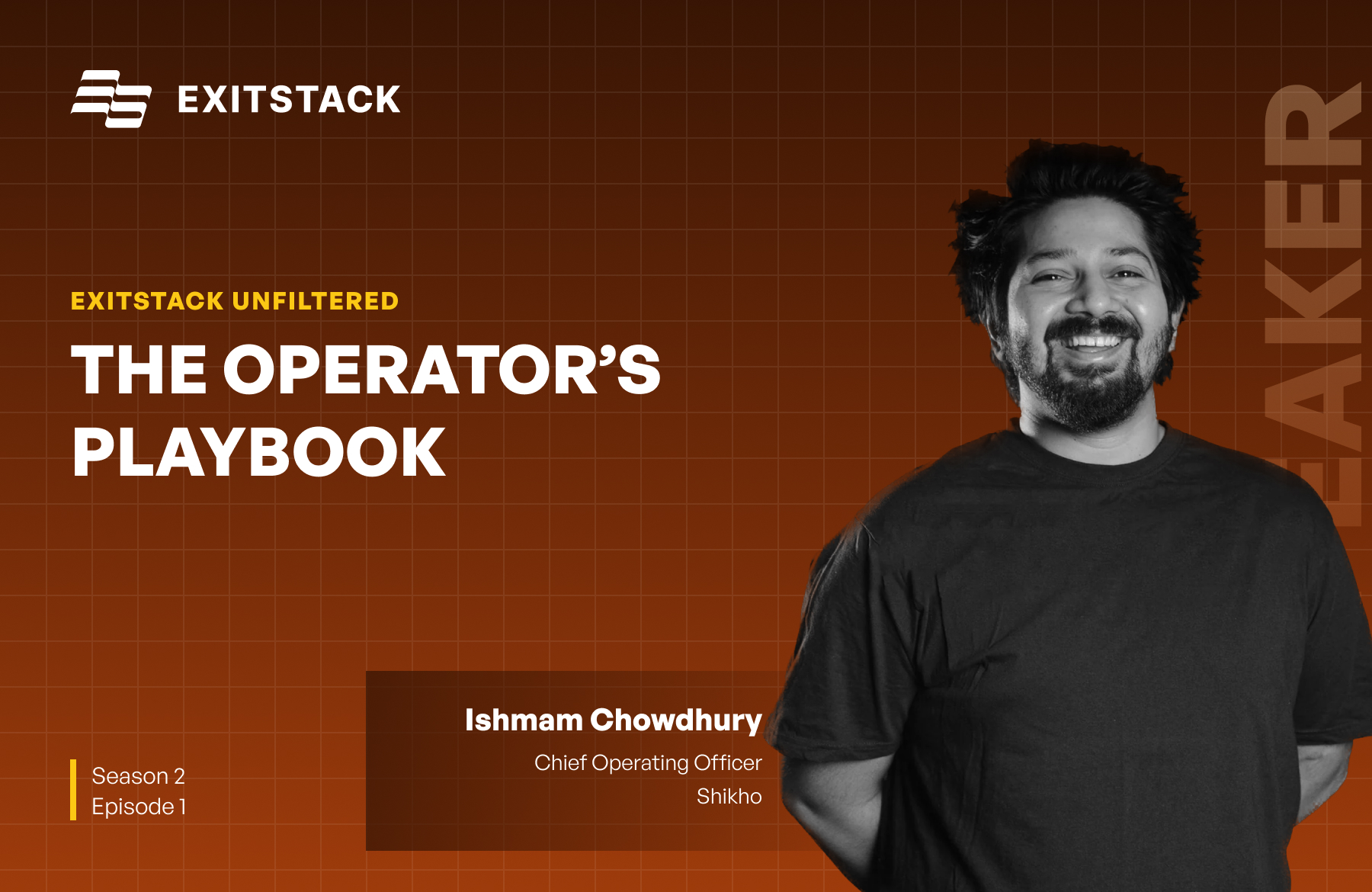
On the first episode of ExitStack Unfiltered Season 02, Shikho COO Ishmam Chowdhury discusses automation, AI-first adoption, keeping a growing team aligned, and why operators should measure everything.
Apple completed its acquisition of Sonera Magnetics, co-founded by BUET graduate and UC Berkeley professor Sayeef Salahuddin, in May 2026. The startup built compact sensors that detect magnetic signals from the brain, nerves, and muscles.
Startup Bangladesh has launched a US$33Mn Fund of Funds to channel public capital through professional venture fund managers. Here's what it means for founders, fund managers, and investors.
.png)



.png)





.jpg)




.jpg)



















.jpg)
.jpg)


.jpeg)


.jpg)


.jpg)


.jpg)
.jpg)

.jpg)
.jpg)