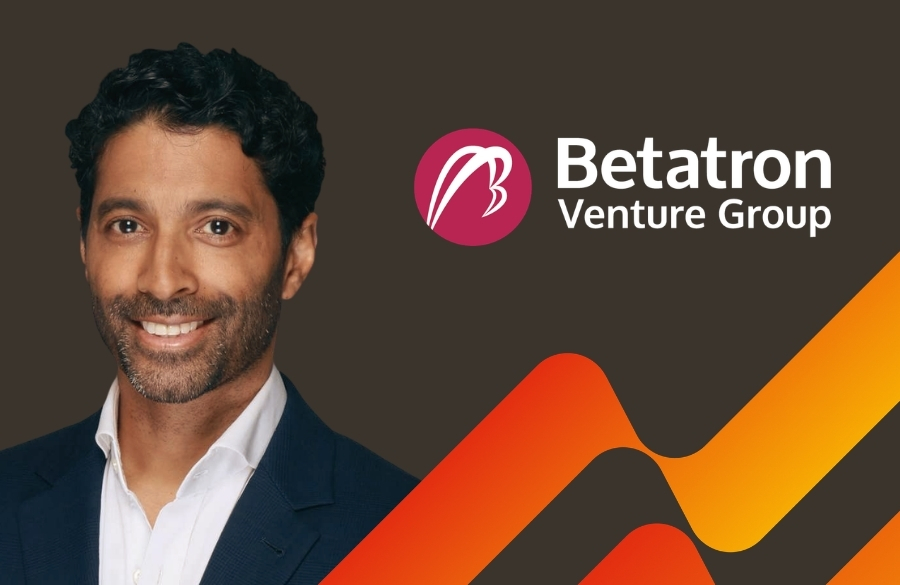
Betatron Venture Group, a Hong Kong and Singapore-based venture capital firm, has raised over US$50Mn across two funds to back asset-light, B2B technology companies across the Asia-Pacific region. "We typically invest US$3Mn to US$5Mn in B2B companies within the APAC region, focusing on construction, manufacturing, logistics, and retail tech," says Arshad Chowdhury, its Managing Partner, in an exclusive conversation with ExitStack. The firm has been deploying quickly—about five investments in the past six to seven months, with more planned before year-end. A Bangladeshi-American who spent two decades as a founder and operator, with two exits, before moving into investing, Chowdhury traces a diaspora arc from a Connecticut childhood to the boardrooms of regional venture capital, and is candid about what holds Bangladesh's ecosystem back and where its real edge lies.
A Diaspora That Began in 1969
Chowdhury's story starts with his father, who left Bangladesh for the Bronx in 1969 to complete his medical residency. He settled in Connecticut, built a practice as a doctor, and returned home to marry before bringing his wife back to the U.S. Chowdhury and his two brothers were born and raised in Connecticut, but Bangladesh was never far. He spent time there every year as a child, often traveling there on his own in high school and college. That dual rootedness has only widened with time—he lived in the U.S. until roughly eight years ago, then moved to Hong Kong. His wife, born in Bangladesh and raised in Hong Kong from the age of seven, he met while she was studying in the U.S.; the family's roots now span the U.S., Hong Kong, and Singapore.
From Banking to Building
Arshad Chowdhury studied at Wesleyan, then, like many of his peers, went to New York for a first career in finance—investment banking at Bankers Trust, which was absorbed into Deutsche Bank, from 1999 to 2001. In 2001, he left finance for an MBA at Carnegie Mellon, with no intention of returning. The decision traced to a plan he had set himself years earlier: "When I was 22, I wrote a plan to spend the first half of my career building companies and the second half investing. It seems the plan worked." The building came first. A napping-pod concept he tested during his MBA, running a trial center in the student union, became MetroNaps—whose pods were later adopted by Google, Procter & Gamble, and Cisco. It opened in the Empire State Building and ran for five years. It still operates internationally today under his business partner’s leadership as AlertForce. He then moved into technology with Crowd Interactive, an e-commerce company building on Ruby on Rails where he rose from salesperson to board member, before founding the HR-tech company ClearGears, which later became InterviewJet. After exiting InterviewJet, he founded Power 20, a fitness app publisher. Power 20 was a strong commercial success, ranked as the number one prenatal workout app on the App Store for almost a decade.
The Pathao Bet
His route back to Bangladesh's tech scene ran through family and trust. His younger brother, Ravid, roomed with Fahim Saleh, the founder of Pathao, and that connection brought the company to Chowdhury's attention; when Pathao was being launched, Fahim asked him to advise, and he turned it down, knowing nothing about ride-hailing. He followed along anyway. As Ravid became integral to Pathao's early fundraising, Chowdhury backed the company early—a bet placed on Fahim and his brother more than on the business model. It paid off: Pathao went on to become one of the first Bangladeshi startups to pass a US$100Mn valuation, and the experience, he says, opened his eyes to what was possible in Bangladesh. His Bangladesh investments compounded faster than several of his U.S. ones, and he could see how much engineering talent the country held, at a time when Bangladeshi developers already made up a large share of the freelancers on global platforms. He went on to advise and back several more local companies, some of which did not work out. "Early angel checks are risky checks," says Arshad Chowdhury.
Why Institutional Capital Finds Bangladesh Hard
Moving from angel investing to an institutional firm sharpened his view of the market's hardest problem. "The real difference is the ability to exit," Chowdhury says, adding: “As an angel, you can exit through secondaries in early rounds. As an institutional investor writing US$3Mn to US$5Mn checks, we have to stick with a company for much longer to avoid sending a negative signal to the market."
In a market without deep later-stage activity, that makes large returns hard to engineer. Chowdhury, however, is careful to frame this as a regional problem rather than one unique to Bangladesh—Series A, B, and C rounds and acquisitions are thinner than they once were across the region, with Southeast Asian startups broadly finding growth capital harder to raise than early capital.
In Bangladesh, those structural gaps are compounded by political instability and, until recently, capital controls—founders have struggled at times even to pay cloud providers under limits on overseas spending, he says. For an investor already absorbing the ordinary risks of an early-stage bet—founder, team, product, market, pricing—layering regulatory, political, and climate risk on top makes an already difficult proposition harder still.
The Constraint Is the Environment, Not the Talent
None of this, Chowdhury stresses, is a verdict on Bangladeshis themselves. "There's nothing fundamentally wrong with the work ethic, the people, the mentality," he says; what limits the country is the environment around them—the political climate, access to capital, and low foreign-currency reserves holding back a large and capable population. He points to the diaspora as the proof: Bangladeshis succeed at the highest levels of nearly every industry they enter. The talent, in his telling, has already shown what it can do once the environment allows it. What founders at home need is simpler than it sounds—capital, fewer restrictions, introductions to investors, and an easier path into international markets.
What's Missing: Corporate and Sovereign Capital
Asked whether local capital at scale—such as the recently launched US$35Mn ONKUR fund backed by 39 Bangladeshi banks—makes a foreign investor's job easier, Chowdhury says it should, because it begins to fill gaps the ecosystem has long carried. Bangladesh has had little active corporate venture capital; the development officers who run it for multinationals sit in distant headquarters rather than in Dhaka, even as corporate VC plays a large role elsewhere in Asia, funding not only startups but other funds. Sovereign wealth, another standard pillar of regional ecosystems, is effectively absent.
Government participation, he argues, also brings the state closer to the ecosystem's real obstacles. "By having more skin in the game, the government might better recognize the blockers to innovation. For instance, if a CEO can't use a credit card to pay for LLMs, how can they innovate in AI?" His hope is that closer contact between investors and government produces regulatory change: "Founders need capital, fewer restrictions, and easier access to international markets."
Betatron's Lens and the Talent Arbitrage
Betatron's own mandate keeps it outside Bangladesh's borders, by design. "Betatron typically invests in companies incorporated in Hong Kong or Singapore to ensure we can enforce contracts and have a path to exit without share transfer restrictions," he says. The Bangladesh opportunity he sees sits at a different layer. "The talent arbitrage in Bangladesh is very clear. Many U.S. companies use Bangladeshi developers for heavy lifting," he says—a pattern he expects to endure. The model that interests him is one built on that arbitrage rather than bound by local incorporation: "If a company sells in dollars or euros globally but maintains a back office or development team in Bangladesh, that is a strong model for us."
Heavy Industry and the Leapfrog
He returns, finally, to the industries he grew up around. Visiting the garment factories and brick kilns that his extended family worked in gave him an early appreciation for the role heavy industry plays in shaping a country. At Betatron, he is now conducting due diligence for companies pushing manufacturing forward with technology, and he believes AI and automation are opening a new era of cleaner, lower-cost, more efficient production. His hope for Bangladesh is that it leapfrogs older technologies entirely—cutting-edge industry and power across the board—rather than inching toward them. Those are the companies that interest him, he says, both personally and for the fund.



.png)



.jpg)




.jpg)

.png)











.jpg)
.jpg)


.jpeg)


.jpg)


.jpg)


.jpg)
.jpg)

.jpg)
.jpg)