Ellipsis Health, Backed by Khosla Ventures and Salesforce, Makes TIME’s 2026 HealthTech List
Ellipsis Health, a San Francisco-based company founded in 2017, is among 500 companies featured in this year’s ranking.
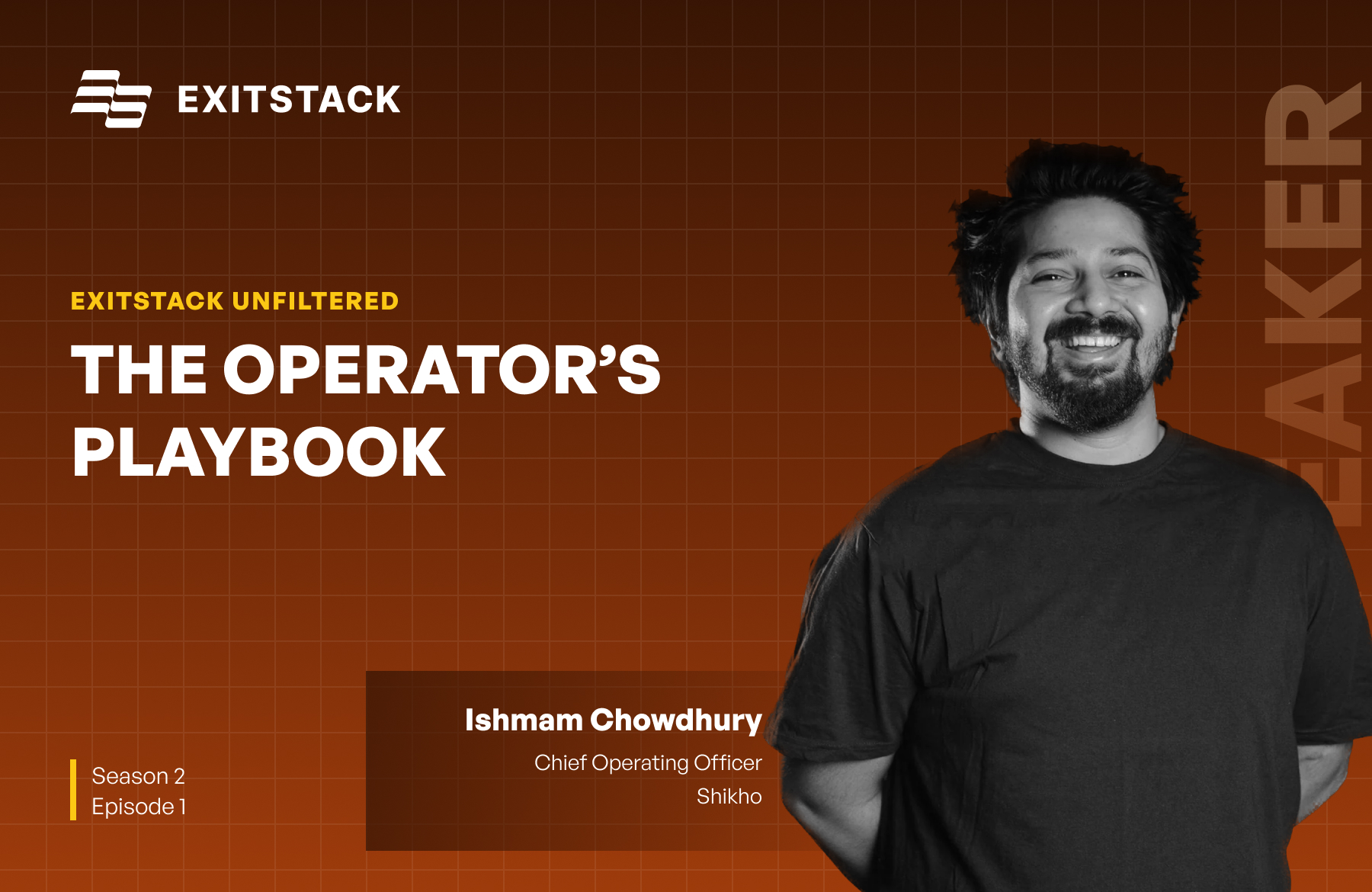


ExitStack Unfiltered is ExitStack's ongoing webinar series, where we host candid conversations with investors, operators, and ecosystem leaders shaping the startup landscape. Held weekly or bi-weekly, these sessions are designed to bring real-world insights and tactical advice exclusively to members of the ExitStack Founders Community. The goal is simple: cut through the noise and surface honest, experience-driven perspectives that help early-stage founders navigate the most critical phases of building a company.
Ishmam Chowdhury is an operator with experience spanning marketing, pricing, strategy, business intelligence, finance, customer experience, and technology. Before joining Shikho in May 2020, he spent six years at Grameenphone, where he rotated across Brand Marketing, Pricing, and Strategy.
Today, he serves as Chief Operating Officer at Shikho, one of Bangladesh's fastest-scaling edtech startups, with more than 3 million registered users and 650,000 monthly active users. He leads a cross-functional organization spanning Sales, Marketing, Customer Experience, Business Intelligence, Finance, HR, and IT, with a focus on translating strategy into systems that can scale.
His career has been defined by lateral moves across functions. At Grameenphone, he moved between marketing, pricing, and strategy to understand how numbers shape narratives, how pricing influences growth, and how strategy connects different parts of an organization.
On the first episode of ExitStack Unfiltered Season 02, Chowdhury spoke about automation, AI adoption, organizational alignment, and what he tells the undergraduates he teaches.
In this conversation, he explains why processes should be treated as disposable, why operators should measure everything, and how AI can help people work across functions.
Edited for clarity.
I joined Shikho in May 2020. At the time, the role was initially called Head of Strategy rather than Chief of Staff, and it was a newly created role. There wasn't a predefined playbook for the position, so one of the first things I had to unlearn was expecting a role to come with a clear task list or handover.
That was very different from what I was used to in a large corporate environment. I had to quickly understand the organization, figure out where I could add value, and start working across different functions. I had to get to know people across the organization, understand how different teams worked, build relationships, and influence people even when they weren't directly reporting to me.
One thing that helped me was my natural curiosity. If you give me a new file, I'll click everything and try to figure out how deep it goes. I spent a lot of time going through information, understanding how different parts of the organization connected, and learning how things worked.
I had also developed a habit at my previous job of creating my own glossary whenever I moved into a new function. When I moved into pricing, for example, I kept a Google Doc explaining terms like ARPU, AMPU, and gross adds. I would write down the abbreviation, the definition, and one sentence explaining how I actually used it.
I did the same thing at Shikho. I didn't come from the startup or VC world, so valuations, convertible notes, SAFEs, customer acquisition cost, and unit economics were all new to me. I understood that nobody was going to take me through a 10-hour onboarding session. I had to learn it myself.
One of the biggest lessons from those early days was around ownership. In a startup, you aren't always going to get a formal process telling you exactly what to do. Sometimes you have to understand the problem, ask the right questions, evaluate the options, and then take responsibility for the call.
That was one of the biggest adjustments for me coming from a more structured corporate environment. You have to be comfortable operating without having every step defined for you. You learn quickly, ask questions, take ownership, and figure things out as you go.
It's a mixture of art and science.
If you have been doing something the same way for the past few weeks or months, I want you to ask yourself: can we do this better? Can we do this differently?
A lot of people just follow a process because that's how it has always been done. But I don't think you should fall in love with processes or workflows. You should put care into setting them up, but once you realize it's time to break them, you should be able to do that. Maybe three months ago it made sense, but now it doesn't. So let's change it.
The first question I ask is: how much pain or annoyance is this process causing you right now? How much do you struggle with it?
You might have 20% or 25% of your work that you dislike doing but have to do because it needs to be done. That is the work we should start automating.
The second thing I look at is how much time the process actually takes. Is it a minute? Five minutes? Is it a minute every week, or a minute every day?
That helps us understand whether we're dealing with a compounding problem and how much time it is actually consuming.
To automate things in an organization, you also need to understand the process end to end. You need people who can see how each step connects, someone who can build the automation, and the time to actually do it.
The first part is still important even with LLMs. You need to understand that Process A, B, and C could perhaps become Process A and B combined into C. To see that, you need to understand what's happening at each stage.
There's a lot of value in connecting those dots.
There was definitely a period when AI was a buzzword, but I think the gains now have made it very clear that it is here to stay.
At Shikho, everyone is still adopting it. The models have improved rapidly, and new ones are being released all the time, but adoption hasn't moved at the same pace. It varies from person to person.
What we're doing is encouraging the entire organization to think AI-first. If there's a task, the old approach would be to do it the way we've always done it and perhaps ask later whether there was a better way.
Now we're asking people to start with a different question: this is what needs to be done, this is how we've done it until now—is there a better way to do this?
A lot of the value comes from that brainstorming. Previously, there might be someone in the organization who was the go-to person for a particular problem. With AI, you can have that kind of conversation and get an explanation in a way that works for you.
The tools are already available to our teams, so we're asking people to integrate them into their existing workflows and see where they can make improvements. No one knows your workflow better than you do.
If someone needs more intensive support, such as coding or building something that works across multiple teams, we also provide access to additional tools.
I've had conversations with other startups in Bangladesh as well. There are companies telling their teams to become AI-first and use these tools, but in some cases they're not even paying for the subscriptions and are expecting employees to pay out of pocket.
For us, if we're telling people to use these tools and encouraging them to integrate AI into their work, we should also put our money where our mouth is and provide the subscriptions.
We're also seeing people build practical internal tools using AI. We recently launched an HR leave management system that the team was able to build using AI, without engineers being involved in the process.
That's the kind of adoption we're trying to encourage: not just talking about AI, but actually finding ways to use it to change how work gets done.
It really comes back to the question: what is the pain we're facing at this moment with the current system?
By pain, I mean two things. First, what is the failure rate of this system? Second, are we creating any side problems because of the way the system works?
For us, student satisfaction is something we will never compromise on. If it's compromised, even if our internal metric shows that complaints have increased by 2% because of our process, and we know that our process has broken, we need to fix it.
A quick example is when we started sending physical gifts to students across the country. We weren't a delivery company, so initially it was spreadsheets and people managing the process. It worked at a small scale.
The problem became clear when students started telling us, "It's been 20 days since I made the purchase. I should have received this by now."
That's when we realized we weren't properly sorting orders by when they were paid for. There was no way to know that one student had paid 50 days earlier while another had paid five days earlier but received their order first.
That was the point where the failure rate became a problem because we were creating dissatisfaction for users. So we knew the process had to change and we made it a proper process.
It's like everyone's asking the toughest questions possible, but it's the most real challenge for us.
As organizations grow, you realize that the vision may be clear to leadership but not necessarily to everyone across the organization. There's also a balance between explaining the vision behind everything we want to do and simply telling people what needs to get done. Because we're so focused on execution, sometimes we can miss the "why" behind the process.
What we try to do to solve this is hold bi-weekly all-hands. Different people speak each time. Sometimes it's someone from academics, sometimes the founder, sometimes me. We talk about what happened over the past two weeks and what we're going to do in the next two weeks.
Otherwise, the message can become a little like Chinese whispers. I tell something to my direct reports, they understand it in a certain way, then they tell their direct reports, and something gets lost in translation. The all-hands gives the organization a clear message from leadership about where we are.
The other thing I still try to do is spend time with people outside formal work settings. It can be in the pantry or while walking around the floor. I want to know people beyond their job function. That creates a relationship where someone can also tell me, "I'm not really sure why we're doing this," and we can have that conversation.
It's a balance. We do something top-down, through the town halls, and something at a personal level. But it's a genuinely tough problem, and one of the biggest challenges of running organizations at this size.
A big part of building your value as a leader is your ability to influence.
Your ability to take an idea and then influence it across the organization is what matters.
The team that I lead now was not the team I was leading when I joined. I had one person as a direct report, and the other responsibilities came to me gradually.
A big reason for that was being able to do certain things and help people with their work. That gave them the idea that I was someone they could trust to have their back.
Over time, that built confidence in my ability to work across different parts of the organization.
The ability to have some influence over Finance, some over IT, some over Business Intelligence, that's how you build that versatility. You do become a jack of all trades, and LLMs can help you operate across those areas.
You don't have to be a Finance person to help your Finance colleague solve a problem. You can use an LLM to understand the problem, work through it with them, and contribute something useful. That may not be part of your job description, but if you see something that needs to be done and step in to help, people notice that.
If I were evaluating that person, I would appreciate that. It shows that they think in the long term.
I would tell them to have the mindset that they are going to measure everything.
Whatever you do, measure it end to end. It can be an experiment, a workflow, or anything else. It could be measured in time, number of clicks, customer acquisition cost, or whatever metric makes sense. There needs to be a number and a measurement system.
Without that, no matter how good your intentions are, you have no idea whether something actually worked.
Once you start measuring things clearly, it becomes much easier to see what worked and what didn't. When something works, you double down on it. When something doesn't, you cannot fall in love with the idea just because you thought it was brilliant. If it didn't work, it didn't work. There can be no ego.
You move on, but you take the learning with you.
The other thing I tell them is to be easy to work with. As an operator, you have to move people with you. You are never going to be a solo individual contributor, so if you're not easy to work with, you cannot influence others.
And becoming easier to work with means putting yourself in uncomfortable situations. Work with people you've never spoken to, take on things that make you uncomfortable, and learn that you can get through them. The more you do that, the thicker your skin becomes.

.png)



.jpg)




.jpg)

.png)















.jpg)
.jpg)


.jpeg)


.jpg)


.jpg)


.jpg)
.jpg)

.jpg)
.jpg)